Patek Philippe brought an unusually varied selection of watches to Milan for its 2026 WATCH ART Grand Exhibition. Among the highlights were three Calatrava models presented in green, red and white, each with a different mechanical purpose. One featured a perpetual calendar, another a minute repeater, while the third kept things considerably simpler with a date display and central seconds.
What made the presentation interesting was the way these watches shared a visual identity without relying on identical specifications. Their white gold cases, lacquered dials and Italian colour references created a connection between the models, but the movements inside told three very different stories.
For anyone following Patek Philippe Calatrava complicated watches, the Milan collection offered a particularly useful look at the relationship between traditional watchmaking and contemporary design. The exhibition also included two World Time Minute Repeaters, a special Aquanaut and an elaborate platinum chronograph with an instantaneous perpetual calendar.
Rather than treating the event as another product announcement, it is worth looking at what each watch actually brings to the collection. The differences are more interesting than the shared colours might initially suggest.
Three Calatravas and Three Different Mechanical Ideas
The green, red and white Calatravas were among the most visually connected watches in the Milan presentation. All three used 38mm white gold cases and lacquered dials with a distinctive carbon patterned centre. Their straps followed the same colour scheme, with the green, red and white details referring to the Italian flag.
The similarities ended there. The green 7147G-010 was built around a perpetual calendar, the red 7047G-010 housed a minute repeater, and the white 7007G-010 concentrated on date indication and sweep seconds.
I think this was a more effective approach than producing three watches with identical movements and simply changing the dial colour. Each reference had a clear reason to exist, and the differences become much more interesting when the technical details are considered.
The Green 7147G Combines a Traditional Calatrava Case With a Perpetual Calendar
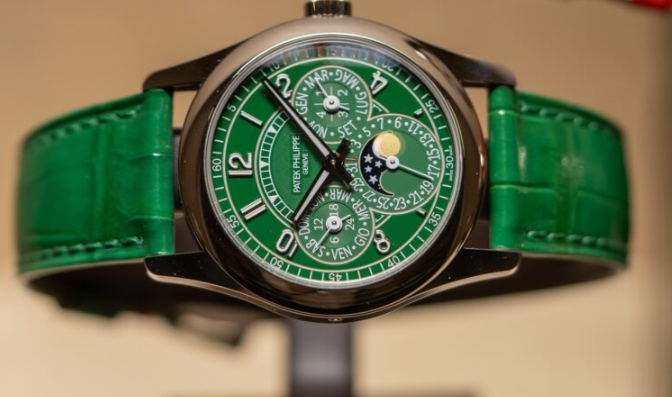
The green 7147G-010 is arguably the most balanced of the three Calatrava editions. Its 38mm white gold case retains the restrained proportions associated with the collection, while the green lacquered dial gives the watch a considerably more contemporary appearance.
The centre of the dial carries a carbon pattern that adds depth without overwhelming the surrounding calendar indications. White gold applied numerals and hands provide contrast, while the matching green alligator strap completes the colour scheme.
The real interest lies inside the watch. Patek Philippe fitted the 7147G-010 with its self winding Calibre 240 Q, a movement incorporating a perpetual calendar and moon phase display.
The calendar indicates the day, date, month, leap year and 24 hour cycle. Unlike a conventional date mechanism, a perpetual calendar is designed to account for the different lengths of the months and the leap year cycle.
The movement measures just 3.88mm in thickness and offers a power reserve of approximately 38 to 48 hours. Its off centre 22K gold micro rotor also helps maintain the relatively slim profile.
The 7147G-010 was produced as a limited edition of 100 pieces. What makes it appealing is the contrast between a relatively simple exterior and a genuinely sophisticated calendar mechanism.
The Red 7047G Puts the Minute Repeater in the Spotlight
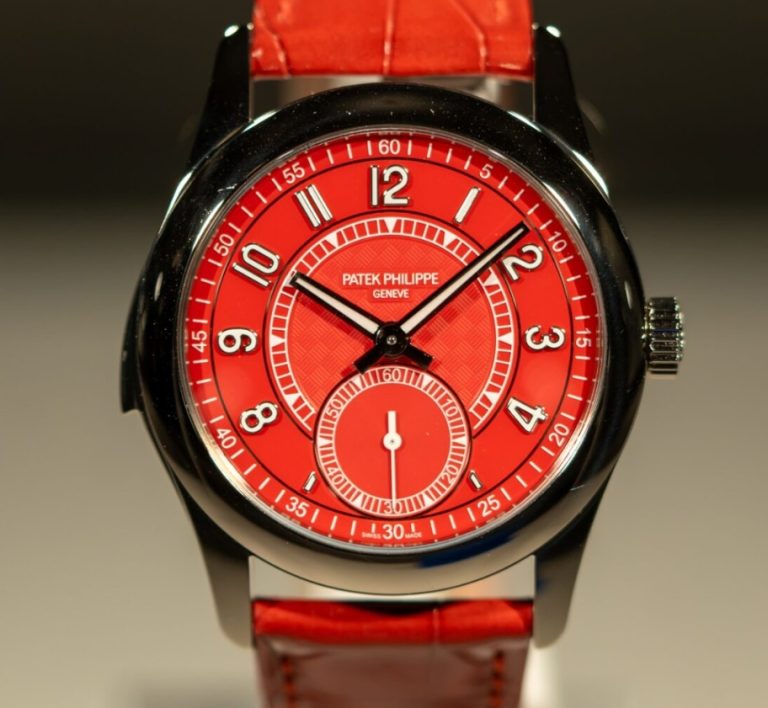
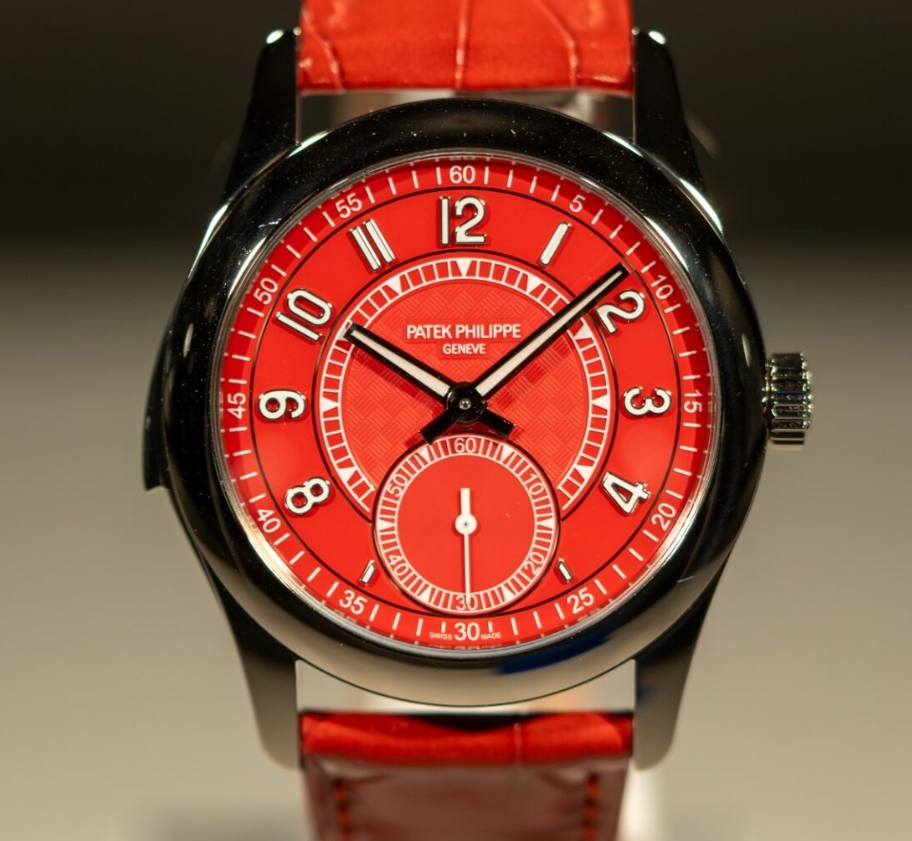
The red 7047G-010 takes a much bolder approach. Its red lacquered dial and matching alligator strap immediately distinguish it from the green and white versions.
The central carbon pattern gives the dial a more technical appearance, while the applied white gold numerals and small seconds display keep the layout readable.
However, the defining feature is not the colour. The 7047G-010 is a minute repeater, one of the most demanding complications in traditional mechanical watchmaking.
Its self winding R 27 PS movement uses two classic gongs to indicate the hours, quarters and minutes through sound. Rather than relying solely on a visual display, the watch communicates the time through a sequence of chimes.
The movement contains 327 components and provides a power reserve of approximately 43 to 48 hours. Its 22K gold micro rotor is decorated with guilloché finishing.
Only five examples of the 7047G-010 were produced for the Milan exhibition. This extremely small production number makes it the rarest of the three Calatrava references.
There is also a practical detail worth noting. Patek Philippe specifies protection against humidity and dust rather than water resistance for this particular model. It is a reminder that a complicated watch should not automatically be treated as an everyday sports watch.
The White 7007G Shows How Much Can Be Achieved With a Simpler Movement
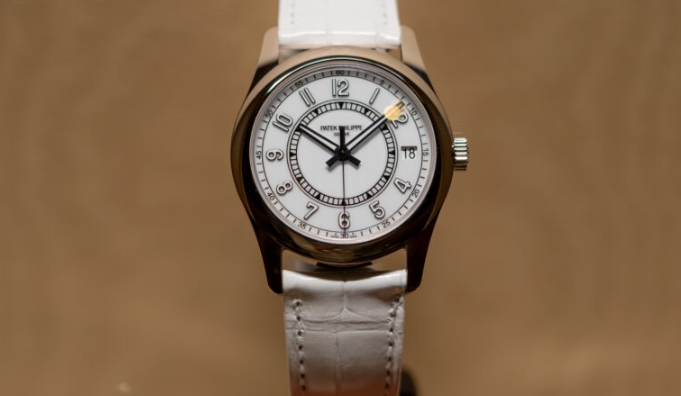
The white 7007G-010 is the most restrained member of the group. Its white lacquered dial and charcoal grey details create a clean appearance, with the carbon patterned centre providing just enough texture to connect it with the other two watches.
At three o’clock, the date aperture is positioned within an otherwise uncluttered dial. The central seconds hand adds movement without introducing the additional counters found on a chronograph.
Inside is the self winding Calibre 26-330 S C. It provides the date display, sweep seconds and stop seconds function, making it mechanically simpler than the perpetual calendar and minute repeater models.
The movement contains 207 components and has a power reserve of approximately 35 to 45 hours.
Patek Philippe limited this white gold reference to 200 pieces. I particularly like its proportions because it demonstrates that a complicated dial is not always necessary to make a watch interesting. The finishing, contrast and overall balance do much of the work.
The Two World Time Minute Repeaters Bring Milan Into the Dial
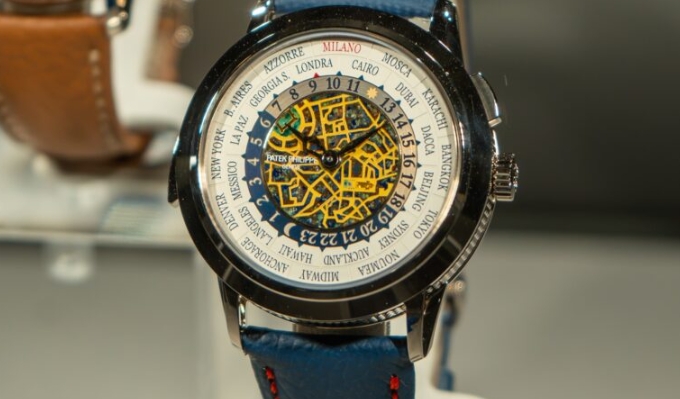
The World Time Minute Repeaters were among the most technically and artistically ambitious watches associated with the exhibition.
References 5531G-012 and 5531G-013 combine two complicated functions: world time and minute repeater. Their white gold cases measure 40.2mm, while the centre of each dial features a cloisonné Grand Feu enamel representation of Milan.
The distinction between the two versions is the scene depicted on the dial. One shows Milan during the day, while the other presents the city at night.
The enamel work is particularly important here. Cloisonné enamel involves forming fine metal partitions to define individual areas of colour before the enamel is applied and fired. It is a demanding decorative technique that requires considerable control.
The movement is the self winding R 27 HU. It combines the world time indication with a minute repeater that can strike the local time shown at twelve o’clock.
The calibre contains 452 components and provides approximately 43 to 48 hours of power reserve. Its construction brings together the mechanical work of the striking mechanism and the practical requirements of displaying 24 time zones.
Both references were limited to five pieces each. The case sides also feature hand guilloché hobnail decoration, adding another layer of craftsmanship to an already complicated design.
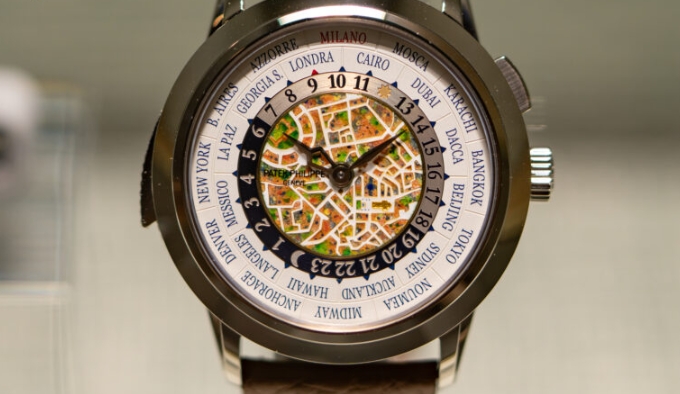
What I find particularly interesting about these two watches is that the world time display is not simply a decorative complication. It has been integrated with the minute repeater so that the watch can announce the local time of the selected time zone.
That is a more meaningful technical achievement than simply adding another ring of city names around the dial.
The Blue Aquanaut Adds a Sportier Side to the Exhibition
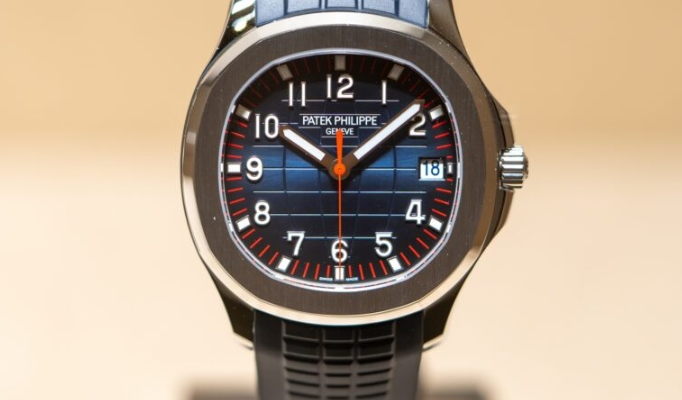
The Milan presentation was not limited to Calatrava and Grand Complications. The Aquanaut 5167A-014 provided a noticeably sportier contrast.
Its 40.8mm stainless steel case is paired with a blue sunburst dial featuring a darker gradient towards the edge. The familiar embossed Aquanaut pattern remains visible, while red accents on the minute track and central seconds hand introduce a subtle reference to the Italian colour scheme.
The watch uses the self winding Calibre 26-330 S C, with a date display at three o’clock and central seconds.
Unlike the leather straps on the Calatrava models, the Aquanaut is fitted with a midnight blue composite strap. Its integrated appearance follows the shape of the case and gives the watch a more casual character.
The 5167A-014 was limited to 250 pieces. It is an interesting addition because it shows how Patek Philippe can interpret the same exhibition theme through a much more contemporary sports watch.
The Platinum 5978P Takes Mechanical Complexity Further
Another important Milan introduction was the 5978P-010, a platinum chronograph combining a manually wound movement with an instantaneous perpetual calendar.
The watch measures 42mm and features a navy blue sunburst dial with a textured centre and black gradient rim. Red chronograph hands provide contrast, while the calendar indications are arranged in apertures.
Its new CH 29-535 PS QI movement contains 500 components. The combination of chronograph and instantaneous perpetual calendar is particularly interesting because the calendar indications are designed to change simultaneously at midnight.
The movement offers approximately 55 to 65 hours of power reserve when the chronograph is disengaged.
The 5978P-010 was limited to 120 pieces. It represents a more technical direction than the three Calatravas, with the platinum case and navy blue dial giving it a relatively understated appearance despite the complexity inside.
What the Milan Exhibition Revealed About Patek Philippe
The WATCH ART Grand Exhibition took place at CityOval in Milan’s CityLife district from 2 to 18 October 2026. It was the seventh edition of the travelling exhibition and the largest presentation organised by the manufacture to date.
The event covered more than 2,900 square metres and welcomed 68,000 visitors, including 400 journalists.
The exhibition went considerably further than displaying new watches. It included historical pieces, archives, current collections, demonstrations of manufacturing techniques and a substantial Rare Handcrafts section.
The latter was particularly interesting because it showed how traditional decorative skills remain relevant to modern watchmaking. Enamel work, hand engraving, miniature painting, micro marquetry and guilloché all featured in the presentation.
The Milan theme also gave the manufacture an opportunity to connect its watches with Italian architecture, art and culture. The city was not merely the location of the exhibition; it became part of the visual language of several limited editions.
Understanding the Difference Between Genuine Complications and Replica Watch Displays
For readers researching Patek Philippe replica watches in the UK, these special editions also illustrate why external appearance and mechanical construction need to be considered separately.
A perpetual calendar is not simply a dial with several calendar indications. It requires a mechanism capable of coordinating the day, date, month and leap year cycle.
A minute repeater is even more demanding. Its gongs, striking mechanism and acoustic construction must work together to produce the correct sequence of sounds.
The World Time Minute Repeater adds another level of complexity by linking the striking mechanism to the selected local time zone.
A watch that resembles one of these references should not automatically be assumed to contain the same calibre or perform the same functions. Genuine Patek Philippe specifications must remain separate from any unverified replica specifications.
For a better understanding of mechanical watch complications and traditional Swiss watchmaking, our watchmaking knowledge section provides additional editorial information about movements, calendars, chronographs and other technical features.
Final Thoughts
The Patek Philippe Milan 2026 exhibition was interesting because it brought together very different expressions of watchmaking under one theme.
The green 7147G demonstrated the appeal of a traditional perpetual calendar. The red 7047G put the minute repeater in a more contemporary setting, while the white 7007G showed how an understated Calatrava can remain interesting through proportion and finishing alone.
The two World Time Minute Repeaters brought together mechanical and decorative craftsmanship, while the Aquanaut and platinum 5978P demonstrated the breadth of the wider Milan collection.
For anyone following Patek Philippe, these watches provide a useful reminder that good watchmaking is not defined by the number of complications alone. It is the relationship between movement design, finishing, proportions and everyday usability that ultimately gives a watch its character.
You can explore more watch articles and editorial coverage on VIP Replica, including Patek Philippe collections, mechanical watchmaking and developments across the wider luxury watch industry.
About the Author