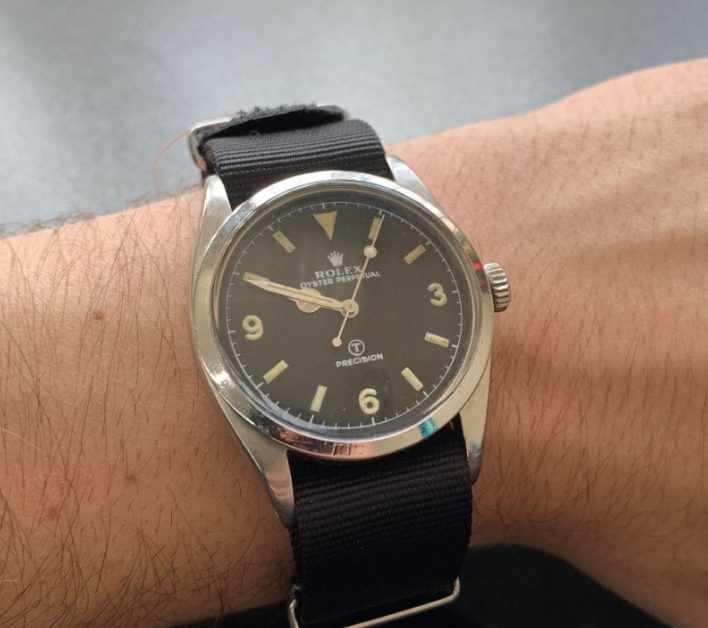
In the years leading up to the Second World War, a Royal Navy diver looked remarkably similar to one from the Victorian era: clad in a brass helmet, lead-soled boots, and a heavy suit made from layers of waterproofed canvas and vulcanised rubber, breathing through a long tube connected to a compressor aboard the support vessel. The war, however, brought about the birth of the modern “frogman”, divers equipped with latex suits and self-contained oxygen supplies. Employed for both reconnaissance and offensive missions, these specialists quickly became recognised as an essential element of any modern naval force. The early frogmen’s watch of choice: the AAA replica Rolex 6150 Explorer.
For these teams to operate effectively, synchronisation was vital. Each diver required a dependable timepiece to coordinate their actions underwater and on land. Yet, at the dawn of the 1950s, no watch existed that could truly meet the demands of military diving. That changed in 1950 when cheap Rolex fake watches introduced the reference 6150 Explorer. The Admiralty swiftly acquired approximately 300 examples and issued them to mine-clearance divers, engraving the case backs with “CD” — denoting “Clearance Diver.”
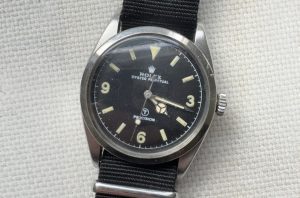
This model remains a little-documented chapter in perfect clone Rolex’s history, often overshadowed by the assumption that the Submariner reference 6538 was the first British military dive watch. The 6150s were issued in two batches toward the end of 1953, and their case backs bear Rolex factory markings ending in “.53.” Powered by the classic A296 “bubbleback” movement, the replica watches UK were not chronometer rated — the chronometer-certified variant, reference 6350, was never issued to the Royal Navy.
When Swiss Rolex replica watches unveiled the Submariner, the Royal Navy immediately recognised the advantages of its rotating timing bezel and ordered the 6538 as a successor to the 6150 Explorer. The older models, however, were retained in service and reassigned for use by dive supervisors, responsible for overseeing the divers’ activities. Consequently, many 6150s remained in operation well into the early 1960s, when awareness of the health hazards posed by radium-based luminous paint began to surface.
During servicing at the Royal Observatory in Herstmonceux, the dials were carefully stripped of their radium lume under running water to prevent radioactive dust from escaping into the air. The dial plates were then sent to Watch Dial (Burford) Ltd. in the Cotswolds, where they were refinished in matte black and reprinted with white numerals and indices containing tritium — a safer, less radioactive compound.
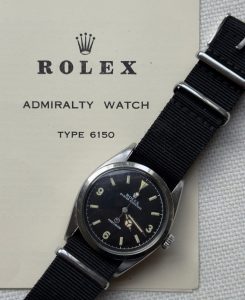
Of the roughly 300 Admiralty-issued 6150s, some were inevitably lost in service, and others likely “disappeared” in less official circumstances. As a result, surviving examples are extremely rare today, each representing a tangible relic of Royal Navy diving history.
It is therefore remarkable to encounter an original example complete with its Burford-refinished dial, engraved case-back issue markings, and even the Admiralty instruction booklet stating: “This Admiralty Rolex Watch, Type 6150, is an expensive, high-precision instrument specially designed for the purpose for which it has been issued to you.”
An evocative artefact from an almost forgotten chapter in top replica Rolex’s military watch heritage.
